Andy Collins

Andy Collins

Even though I like to think that I have an eye for abstract minimalism, I feel completely dwarfed in comparison to artists who painstakingly formulate their work to take on a deceivingly simple and straightforward aesthetic. Andy Collins is one such artist.

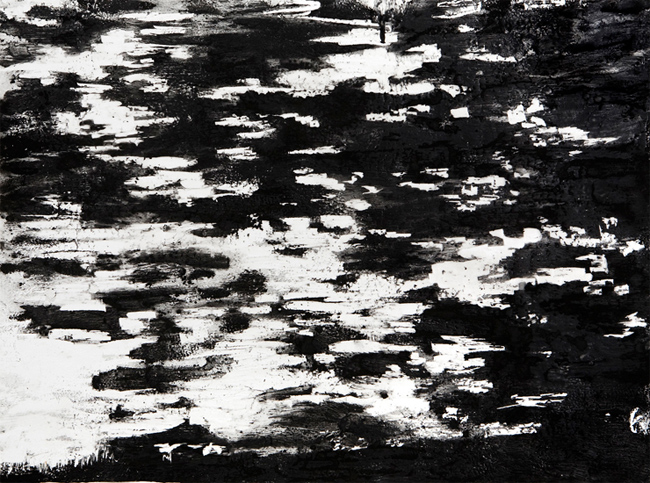
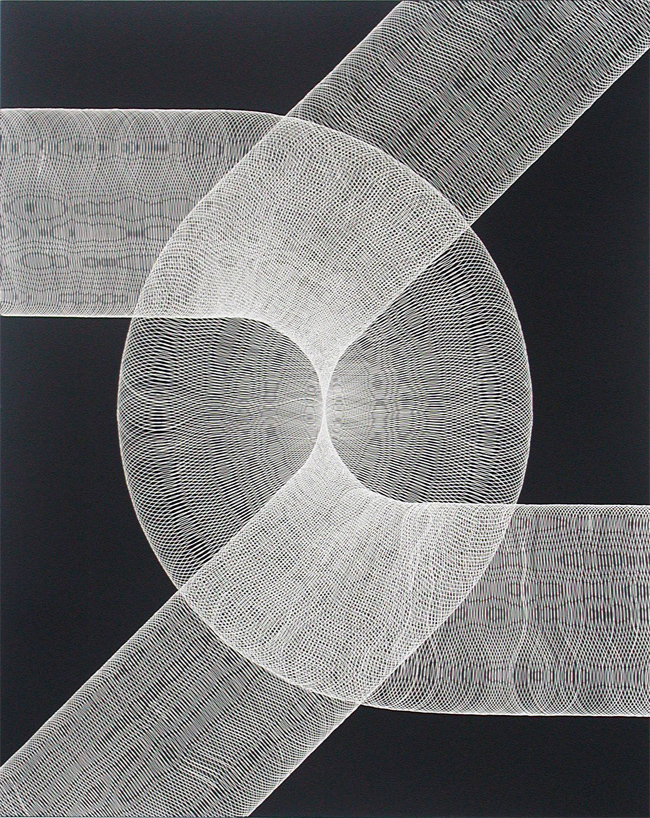
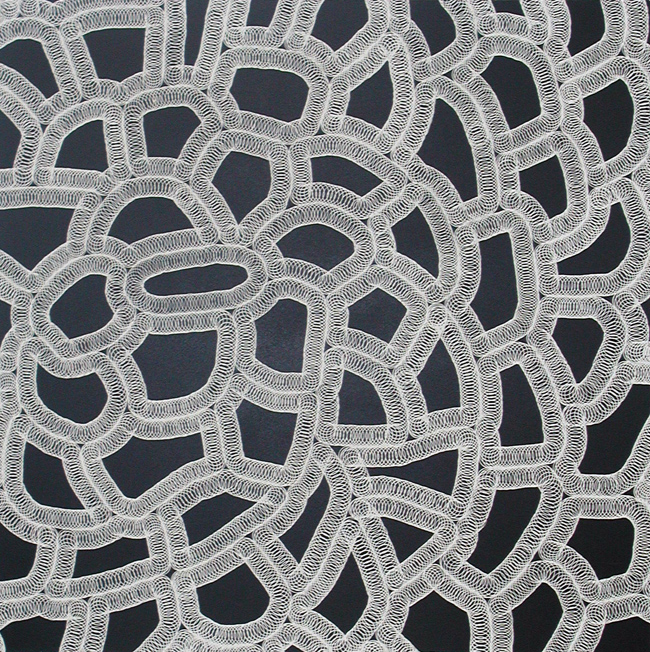
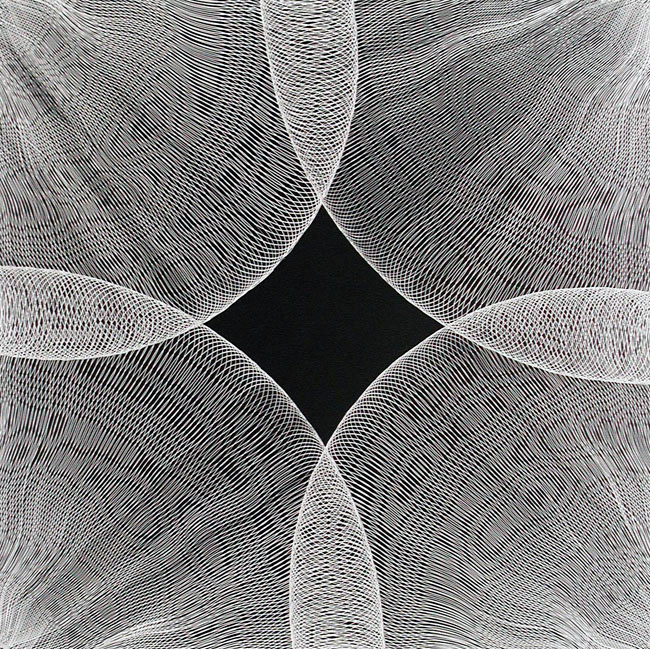
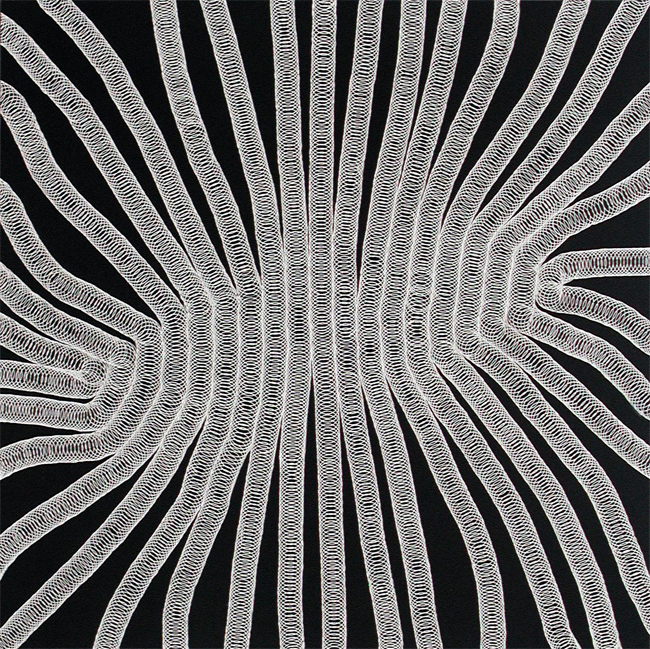
Andy Collins’s paintings are lusciously synthetic. Cold and glossy, his large pastel canvases are suffocating vacuums of glamour. Working from fashion photos, Collins’s abstracted forms are derived from the overlooked in-between spaces of supermodel spreads. Folds in fabric, creases in elbows, knees and armpits become a pattern of fetishised contemplation. Their contours are retraced and suggested forms are embellished, creating ethereal motifs that are both organic and electrifying. Collins’s process is one of almost perverse fixation. Taking several months to complete a painting, he painstakingly constructs his airless forms entirely by hand, leaving no trace of brushwork.

Andy Collins

Andy Collins

Reducing recognisable forms to their barest essentials, Andy Collins’s [work] is neither abstract nor figurative; but rather hosts a supernatural quality of inbetween-ness, an embodiment of aura and retention. Collins uses this subliminality as a departure point for mystical experience. Fixating on the suggested contours of forms, he slips between these cracks, physically exploring the workings of his image from inside-out; caressing its creases, savouring the possibilities of their imagined space. Through his intensive process of painting, Collins addresses the links between physicality and memory, the frailties of perception lifts into an expansive field of wonder and entrancement.

Andy Collins

Andy Collins develops his forms from the sensuous suggestion of magazine layouts: tracing the gaps created by necklines, folded knees and flirtatious ripples in fabric. His paintings reproduce the sexual frisson of glimpsing up a skirt, the electric fixation of imagining what lies beneath. Through his intensive painting process, Collins’s titillating forms melt into mesmerising abstractions. Contemplation of negative space takes metaphysical form, a knowledge gained not only from seeing, but experiencing silky textures and promising depths. Through the physicality of making, Collins’s figurative subjects are expressed in abstract fields, as synthetic and emotionally distant as his sources. (Saatchi Gallery)

Happy Canada Day

Charlotte Town Meeting

The Charlottetown Conference was held in Charlottetown, Prince Edward Island, for representatives from the colonies of British North America to discuss Canadian Confederation. The conference took place between 1–9 September 1864. The above image is of delegates of the Charlottetown Conference on the steps of Government House.

Canadian Confederation was the process by which the federal Dominion of Canada was formed beginning July 1, 1867 from the provinces, colonies and territories of British North America. The following image is of a scene at the Centennial of Confederation – a hundred years after 1867.

Centennial Of Confederation

Today is July 1 – Canada’s 142nd birthday. Happy Canada Day!

Penang circa 1920

Penang is one of the thirteen states that make up Malaysia. It is an island off of the West coast of Peninsular Malaysia, separated by the Straits of Malacca. When I was young, my parents would often take me to Penang for weekend vacations. What I remember most of these vacations were the (excellent) food, the islets, the 13.5-kilometre Penang Bridge, and the harbour. I really loved the harbour. There was something about it – the soft breeze, the undulating waves – that just kept me spellbound…

Penang 1910

Penang 1910

Javier Mariscal

The first time I came across Javier Mariscal’s work – some surreal-cartoonish chairs – it blew me away. It forced me to reevaluate my perception of furniture and our relationship with it. Of course, I then went on to find out more about his work, only to realise that he did a lot more than furniture! His diverse body of work spans kooky cartoon characters to stunning interiors, from furniture to graphic design and corporate identities!

Mariscal’s intense relationship with drawing and illustration is central to his career and is the basis for his designs over the last 30 years. He has been particularly influential in shaping the graphic identity of Barcelona – his rise to prominence occurred at the same time as the city was being extensively regenerated in the runup to the Olympics, and the impact of his colourful, cheery designs can be felt everywhere in the city. To celebrate his contributions to the Spanish design scene, Design Museum is putting on a retrospective that aims to give a flavour of the sheer diversity of Javier Mariscal’s output – displaying sketches, designs, films, photos, furniture and textures within an immersive, fully illustrated environment designed by Mariscal himself. (Digital Arts)

The exhibition will be a fully illustrated environment, rich with orchestrated scenarios and installations, each telling the story of Mariscal’s pivotal projects, designs and the drawings that shaped them. This is one of them:

Javier Mariscal 1

Javier Mariscal 3

Javier Mariscal 4

Fantastic! More on the exhibition at Mariscal Drawing Life.

Nick Ballon

Nick Ballon is a London-based photographer who takes delight in capturing the quirks of everyday life, and suspending its idiosyncrasies and minutiae in his work. [His work is] coloured by a fascination in location – or rather a curiosity about the hidden stories behind his locations. This has taken Nick from the from the motor-way services at Fleet and Ford technical facility in Essex to the space rocketing competition in Ljubljana, and the Chacaltaya ski resort in Bolivia. Each location is selected for its suggestion of untold narrative, which [he] aims to hint at in his work.

Nick Ballon

Nick Ballon

Nick Ballon

Nick Ballon

Sasketchewan International Raceway

Sasketchewan International Raceway (SIR)

Western Canada’s oldest racetrack, Sasketchewan International Raceway was built in 1966 by Les Howard. It was first called “Southwinds Dragway” and later changed to “Saskatoon International Raceway” (SIR). In 1986, the Saskatchewan Drag Racing Association (SDRA) became the track operators and changed the name to “Saskatchewan International Raceway”. In the ‘70’s SIR was a regular stop for the touring race teams during the match racedays. This was time when racecars and their drivers had names that become whatlegends and memories are made from. It was during this popular time that Jerry “The King” Ruth, “240 Gordie” Bonin, Rob Bruins in the “Green Elephant, Jeb Allenand the “Praying Mantis”, Terry Capp and his “Wheeler Dealer”, and “Gentlemen” Hank Johnson all made regular stops at SIR.

Information obtained from Sasketchewan International Raceway.

Arthur Rackham

When I was younger, I had a very old children’s book, given to me, filled with beautiful illustrations. I never cared for the fairy tales and folklores the book contained, but the illustrations were magical. They really brought the out the spirit of the stories – all the enchantment and fantasy was very alluring. Unfortunately, over the years, the book went missing. I don’t even remember the title of the book anymore, but I remember the illustrations very vividly. Today, I stumbled upon a collection of illustrations by Arthur Rackham, and as chance would have it, he was the illustrator, and the book – “Some British Ballads”:

Arthur Rackham: Clerk Colvill

“Arthur Rackham was born in 1867 into a Victorian age that he perpetuated and documented by way of his art. He was one of twelve children. He studied at the City of London School where he won prizes and a reputation for his art. At the age of 18, he became a clerk. It was, after all, a Dickensian world as well, where clerks played a significant role in both fiction and real life. He clerked and in his spare time studied at the Lambeth School of Art.”

“The roots of [his] style [are] evident in many of [his early books], but a flowering took place in 1905 in a stunning edition of the old Washington Irving classic, Rip Van Winkle. It was Rackham’s first major book… Rackham painted 51 color plates, tipped-in and gathered together at the rear of the book. They featured all of the traits that were soon to be as famous as his signature, including sinuous pen lines softened with muted water color; forests of looming, frightening trees with grasping roots; sensuous yet chaste fairy maidens; ogres and trolls ugly enough to repulse but with sufficient good nature not to frighten; and backgrounds filled with little nuggets of hidden images or surprising animated animals or trees.”

Arthur Rackham: The Ring

“Most obvious, in retrospective, is the calm and good humor of the drawings. They seem imbued with a gentle joy that must have been reassuring to both the children and their parents. Rackham had found his niche. His drawings would convey a non-threatening yet fearful thrill and a beauty that was in no way overtly sexy or lewd. It was a perfect Victorian solution and he seems to have taken to it with an impish delight.”

Arthur Rackham: Young Bekie

“He never lost the joy and sense of wonderment and he never gave in to the baser styles that fell in and out of favor over the years. From Queen Victoria’s death in 1901 to the start of World War I, Rackham’s illustrations preserved a lifestyle and a sensibility that kept the frighteningly modern future at bay. His beautiful drawings were the antithesis of the industrial advances that allowed them to be printed at affordable prices. Even into the twenties and thirties, his art was a constant reminder of those aspects of innocence that had been left behind. He always kept his gentle humor and his Wind in the Willows, published posthumously in 1940, is as much a children’s classic as his Peter Pan.”

Arthur Rackham: The Two Corbies

Rackham died in 1939.

Text sourced from Been Publishing.

Cold Souls

“In the surreal comedy, Cold Souls, Paul Giamatti plays an actor named… Paul Giamatti. Stumbling upon an article in The New Yorker about a high-tech company that extracts, deep-freezes and stores people’s souls, Paul very well might have found the key to happiness for which he’s been searching. But, complications arise when he is the unfortunate victim of ’soul-trafficking’. Giamatti’s journey takes him all the way to Russia in hopes of retrieving his stolen soul from an ambitious but talentless soap-opera actress.” (SlashFilm)

The poster itself is a wonderful foreshadowing of the (utterly unrealistic yet so compellingly bizarre) plot. And I will be the first one in the lineup when it opens in August!

Cold Souls

Cold Souls

Cold Souls

Stanley Wong

If you grew up in an Asian country, you will undoubtedly recognise the ubiquitous blue-red-white tarpaulin used in Stanley Wong’s redbluewhite – a collection of posters, photographs, artwork and installations centred around the material. Uprooted from my country of origin, this collection very much brought me back to those good old days when my grandmother would, during her weekly Sunday visits, carry a bag made of this material containing breakfast and treats for me…

Stanley Wong

Stanley Wong

Though its origins may be obscure, the cheap, durable and multifunctional red, white and blue nylon bag has served many an émigré returning from Hong Kong to China over the years, bearing gifts and foodstuffs for friends and relatives in their native province. Even today, many still use the bags to store or transport things.

Since 2000, Stanley Wong has been incorporating this quotidian and ubiquitous motif into his photography, poster designs and installation art, in an effort to epitomize the Hong Kong spirit so well encapsulated by it. The significance behind this red, white and blue, however, is very different from the themes of liberty, egality, and fraternity underlying that of the French tricolour. The subject-matter of RedWhiteBlue-Building Hong Kong echoes the industriousness and struggle of the Hong Kong people in the 1960s: starting out with nothing, they succeeded in constructing the metropolis that is present-day Hong Kong with their fortitude, positivity and adaptability.

Stanley Wong

In his work, Wong retains the original sturdy material, but has come up with numerous variations on the tricolour stripes. Through deconstructing, reassembling and recombining the familiar pattern, he has brought to it a completely novel feeling, breathing ample new life into this mundane and oft-neglected “found object” – much like the “Hong Kong spirit” that the designer values above all else. (Hong Kong Design Professional)

Stanley Wong

Stanley Wong

“From the graphic designer’s point of view, the red-white-and-blue combination lies somewhere between the beautiful and the grotesque. But, like a screw, it is full of creativity and usefulness. It is part of life and living in Hong Kong and symbolizes its hardy and hardworking people.” – Stanley Wong

Erin Morrison

When she was eighteen, Erin Morrison remembers wanting to be a medical illustrator. At the time it seemed like a perfectly logical solution for someone who had the ability to depict what lay before her, while satisfying the constant urge to explore the make-up of things. Due to the fact that she had no patience to study and memorize every portion of a frogs entrails (besides the practical application of using medical terminology to impress friends), she decided to skip the step of medicine and explore the substitution of it’s importance with polluted, imaginative thought.

From Morrison’s experience of frequent trips through the Ozark mountains in Arkansas, she found herself constantly invigorated when immersed in a place congested with natural formations, wildlife, and overgrowth. Since her move to the city of love, forgiveness, and an ever-appreciated respect for nature, she has found that manufactured patterns has no place in her work. More than anything, these pieces reflect organisms and plant-life (among a plethora of medical diagrams in text books) mutilated by the element of man. (William Bennett Gallery)

Erin Morrison: Metropolitan Park

Erin Morrison: Protected Forest

Erin Morrison: Bipolar Magnetic Field

Erin Morrison: $2300 1BR 1B Luxury

Ricardo Rangel

I own up: I really thought much of the entire continent of Africa (with the exception of South Africa), revolved around civil wars, overpopulation, famine, bloated malnourished children, widespread AIDS, and, of course, safaris. Surely a place so ravaged by misfortunes could not foster and nurture the needs of a contemporary photographer – one who does not work for National Geographic?

Naturally, I was wrong. Enter Ricardo Rangel.

Ricardo Rangel

Ricardo Rangel (b. Mozambique, 1924) photographs street scenes, landscapes, the everyday activities of individuals, and night scenes in the cafes and restaurants in Mozambique. His work testifies to his great involvement with the people of Mozambique’s multi-cultural society. The photographs are pervaded by compassion for those portrayed and fury at injustices. Rangel worked some time for various newspapers. In 1970, together with four other journalists, he established the illustrated weekly magazine Tempo. This was the first colour magazine in Mozambique. In 1981 he became director of the weekly Domingo, and three years later he was asked to set up the Centro de Formaçao Fotográfica in Maputo, a school for photography. He remains its director down to the present day.(Noorderlicht)

Ricardo Rangel

Sadly, Rangel passed away in early June. Speaking at Rangel’s funeral, in Maputo City Hall, Prime Minister Luisa Diogo praised Rangel for using his camera “to denounce colonial dictatorship”. She recalled that in the final years of the Portuguese colonial regime, Rangel had been harassed by the Portuguese secret police, the PIDE, and some of his photos had been banned. Much of his work from that period, Diogo noted, could only be published after independence in 1975. (AllAfrica)

Ricardo Rangel

“He was much more than a photographer”, Diogo said. “He used photography as a weapon against colonialism and foreign aggression”. The general secretary of the National Union of Journalists (SNJ), Eduardo Constantino, added that, in building the new Mozambique after independence, Rangel “condemned the new injustices, the deviations and the errors”, and “continued to fight for better quality in our journalism”. (AllAfrica)

Ricardo Rangel

It is such a shame that much of his old negatives, pre-Independence, were destroyed. From what I can tell of his work, they certainly capture views of Africa that I do not know. And I believe most of the world do not know of this side of Africa, as we are consistently fed by media portrayal which favour stock images of starving children with flies circling them and young boys with guns and rifles.

Up Colour Script

Children’s movies have changed so much from when I was one myself. The simple 2D animation have been replaced with 3D characters and settings. You can even watch entire movies with 3D glasses in select cinemas! Disney certainly has come along way since the Aladdin/Little Mermaid era, with stories that are not the traditional children’s tales, but capture that youthful imagination all the same, like its new movie, called ‘Up’. You may have already seen this movie, but what’s more interesting than seeing the final artwork is seeing the artwork during story development. Colour scripts are like less detailed story boards, capturing the desired mood visually. Here are some of Lou Romano’s (an Art Director at Pixar) colour scripts for ‘Up’:

Lou Romano: Up 1

Lou Romano: Up 2

Lou Romano: Up 3

Lou Romano: Up 4

Lou Romano: Up 5

Lou Romano: Up 6

Lou Romano: Up 7

Lou Romano: Up 8

Lou Romano: Up 9

Up has already been released. You can view the trailer here and see how Romano’s artwork has translated into the final depiction.

Tom Thomson

I have already brought up in the past. But I am bringing him up again because his work is just endlessly fascinating and exciting. He paints idyllic Canadian landscapes, and they certainly capture the spirit and essence of our beautiful Canadian natural environments, but every tree and shrub present are almost always clearly distinguishable: you can tell where a tree begins and another ends. I have not seen one that is so deliberately painted in a heavy-handed manner as the following, as to render the painting rather abstract:

Tom Thomson: Birches And Cedar

The oil on panel, circa 1915, titled ‘Birches and Cedar’, is embossed with the Thomson estate stamp and highlights the ever-changing fall landscape of the Ontario woods.

Trenton Doyle Hancock

Trenton Doyle Hancock

“Hancock is well known for evolving his absurdist narrative of the battle between good and evil executed across a wide variety of media that includes painting, collage, sculpture, print and the performing arts. The artist’s densely layered works incorporate text, drawing, collaged paper, plastic, felt, fur and paint to create a collision of symbols and visual tropes that evidence Hancock’s singular vision and distinctive means of storytelling.”

Trenton Doyle Hancock

“[In this series], Hancock continues a retelling of his sprawling, epic battle between the forces of good, as represented by Mounds and their color-filled world, and evil, as embodied by the skeletal Vegans who live underground in a world of black and white. Peaceful creatures, Mounds survive on Mound Meat, a pink substance that once ingested allows all to experience a life of color. At the center of Hancock’s tale are two pivotal characters: Vegan leader, Betto Watchow, and enlightened Vegan prophet, St. Sesom, who introduces Vegans to the world of color. Betto views Sesom’s proselytizing as traitorous and fears his increasing power. In reaction, Betto launches an all out war against Sesom, his disciples, and the Mounds.” (James Cohan Gallery press release)

Trenton Doyle Hancock

What it must be like to live inside Hancock’s imagination…

Igor Stravinsky

Igor Stravinsky was born on this day, in 1882.

Igor Stravinsky

One of Time magazine’s 100 most influential people of the century, he was a composer of great stylistic diversity, first gaining international acclaim with his three ballet commissions (The Firebird, Petrushka and The Rite of Spring). He also published a number of books throughout his career, almost always with the aid of a collaborator, sometimes uncredited. In his 1936 autobiography, Chronicles of My Life, written with the help of Walter Nouvel, Stravinsky included his infamous statement that “music is, by its very nature, essentially powerless to express anything at all.” And, of course, he was also rumoured to have had an affair with the great Coco Chanel.

Information sourced from Wikipedia.